

News
ITALY – MILANO CORTINA 2026: FILMMASTER ENCHANTS THE WORLD FROM THE ARENA DI VERONA WITH MUSIC, DANCE AND VISUAL ARTS FOR THE OLYMPIC CLOSING CEREMONY — A RECORD-BREAKING “TOP MARKS” EDITION FOR ITALY
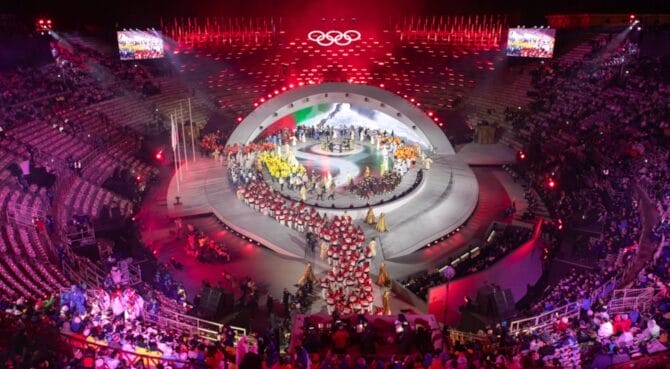
Beauty in motion, in all its forms, was at the heart of the Closing Ceremony of the Milan Cortina 2026 Winter Olympics, titled “Beauty in Action” and produced by Filmmaster. On February 22 the company transformed the Arena di Verona into a living, ever-changing space through a sophisticated high-tech scenography inspired by a drop of water — symbol of a natural cycle connecting mountains, plains, cities, lagoon, sea and sky.
The Roman amphitheater was reimagined as a great Italian piazza with no clear separation between stage and audience. A kaleidoscopic show unfolded in which choreography, luminous surfaces and collective movements animated the space, celebrating the conclusion of the Games — a moment marked by festivity after days of tension, effort and sacrifice — and thanking all those who made possible the first distributed Winter Olympics, a model set to continue with the 2030 French Alps edition.
The ceremony extended beyond the Arena to Piazza Bra and the Teatro Filarmonico, where the choir and orchestra of the Fondazione Arena di Verona performed.
Television audiences were significant: the live broadcast on Rai 1 reached 6,232,000 viewers (30.9% share), confirming strong national interest. The show also received international attention. NBC described the ceremony as “grand, full of soaring and euphoric notes,” The New York Times highlighted the unique combination of contemporary music, opera and national anthems, and CBS praised how the ceremony “brought together Italian culture and the Olympic spirit inside the ancient Roman amphitheater.” French media echoed the enthusiasm: Le Monde called it “a tribute to the beauty of Italy,” while Le Parisien summarized it as “a splendid ceremony after 16 days of competition.”
The evening sealed the success of the Games and strengthened Italy’s image as an international stage capable of blending tradition and innovation.
Opera, dance, music, cinema, design and technology merged into a narrative celebrating Italian creativity and its ability to transform aesthetics into emotion. Around 800 people — production teams, creatives, technicians, artists and musicians — took part. The storytelling format conveyed the Olympic legacy through immersive imagery, multidisciplinary performances and cutting-edge stage technologies.
The creative team was led by Alfredo Accatino, President of Filmmaster, alongside Adriano Martella (creative director), Stefania Opipari (show director), Stefano Ciammitti (costume designer), Michele Braga (music director) and Claudio Santucci (set designer).
A key element of the ceremony was the use of immersive technologies and low-impact scenic systems. Choreographed drones, architectural mapping and modular platforms created a fluid narrative capable of turning the Arena into a storytelling device.
Music accompanied the entire performance with a blend of contemporary repertoire and references to Italian tradition. Actor Francesco Pannofino opened the show, summoning performers and revealing backstage activity to the public.
The stage featured the great Italian opera repertoire, with iconic characters such as Rigoletto, Madama Butterfly, Figaro and Aida. Rigoletto, portrayed by Stefano Scandaletti, descended from a chandelier and theatrically rode a bicycle to the nearby Teatro Filarmonico for a symphonic interlude before returning to the Arena, accompanied by the Fondazione Nazionale della Danza/Aterballetto company and images from photographer Marco Delogu’s project Faces of Italy.
At the heart of the ceremony was the tribute to the athletes: over a thousand competitors paraded together without national divisions, turning the Arena into a shared square. Among the most emotional moments was the entrance of the Italian flag and medalists to Il Canto degli Italiani, introduced by Paolo Fresu’s trumpet and performed by the Arena Choir.
Organizing Committee President Giovanni Malagò celebrated the Games: “Well done Italy, you kept your promises. This edition opened a new chapter in Olympic history. I am even prouder to be Italian.” He praised the athletes for achieving the country’s richest medal haul ever: 30 medals — 10 gold, 6 silver and 14 bronze.
The Olympic flame entered in a glass vessel created by Murano master Lino Tagliapietra and carried by cross-country skiing champions Maurilio De Zolt, Flavio Vanzetta, Silvio Fauner and Marco Albarello.
Historical costumes from the Verona Opera accompanied the delegations’ parade while iconic Italian film scores played, including A Fistful of Dollars (Ennio Morricone), Il Postino (Luis Bacalov) and Amarcord (Nino Rota). Athletes then entered to famous Italian pop songs performed by Calibro 35 in a mash-up featuring Caterina Caselli, Ricchi e Poveri, Gino Paoli, Mina, Loretta Goggi, Rino Gaetano, Massimo Ranieri and Paolo Conte. They took their seats to Senza Fine by Gino Paoli, also honoring Ornella Vanoni.
Dance returned to the spotlight with principal dancer Ramon Agnelli and 16 performers presenting Elevation, a tribute to the athlete’s most fragile moment — the final meter and the challenge of surpassing one’s limits.
A powerful visual highlight came with Roberto Bolle emerging from a trapdoor for Water Cycle, a choreography inspired by the water cycle, culminating in a rising circle turning into the sun while two gondolas evoked Venice. Joan Thiele closed the sequence with a delicate version of Il Mondo by Jimmy Fontana.
A video tribute thanked nearly 20,000 volunteers aged 18 to 80 from over 70 countries; some appeared on stage performing to Blue with DJ Gabry Ponte. After official speeches and the handover to the next host countries, the two Olympic cauldrons of Milan and Cortina were extinguished to Gloria Campaner’s piano performance of Experience by Ludovico Einaudi.
Major Lazer featuring Alfa and other artists energized the Arena before Achille Lauro performed Incoscienti Giovani.
The ceremony, made possible by the work of the entire Milan Cortina 2026 Organizing Committee — from CEO Andrea Varnier to ceremonies director Maria Laura Iascone and the entire Foundation team — officially closed with images of Rigoletto in the Arena’s underground corridors shutting the “magic box,” declaring the XXV Winter Olympic Games concluded.
Milan-Cortina 2026 will continue on March 6 with the Paralympic chapter, also opening at the Arena di Verona and again creatively produced by Filmmaster.